Tuesday, May 9, 2017

Authors: Letter to a New Author


Letter to a New Author

I consider myself an accomplished author. I’m not a best-selling author . . . yet. I’ve learned a lot over the five years that I’ve been “writing as more than a hobby.”

I was asked by a friend to contact another of her friends. The other friend had finished writing a novel and was wondering what to do with the manuscript.

In recent weeks, I’ve read several blogs about this situation. A common theme is to find an agent. That is the mantra if you plan on submitting your manuscript to a mainstream publishing house. I do not have an agent. Perhaps I should. But, that’s for another blog.

Today, I offer the content of the letter I sent in response to my friend’s request for her other friend. It is a succinct presentation of the publishing world as I see it at this time.

Congrats on finishing your novel!

I've had several experiences in the world of publishing. I'm happy to share with you.

I'm going to direct you to my blog first. This link
http://crdowning-author.blogspot.com/2015/05/mapping-path-to-your-book-on.html
leads to a post on publishing through Amazon. I'd start there. 

Questions for you to answer:
1.    Have you had any professional editing or proofreading done on the manuscript? If no, you need to rethink that position and pay to have at least a proofreader go over the manuscript. See this blog post: http://crdowning-author.blogspot.com/2016/02/editing-lessons-learned-hard-way.html
2.   How much control do you want over the book's look, advertising, and cost? Traditional publishers are decreasing in number and number of publications. Most won't accept manuscripts unless they come through an agent. Independent publishers are located along a continuum. Nearly all require money from you to publish your book. The return on your investment varies, but will most likely be less than you thought or hoped it would be. Self-publishing is the biggest now. It's fast. It can be free. It can be a great route to take. However, if you don't have a clean manuscript and an eye-catching cover, it can be your death as an author.
I've also published a booklet on story writing and another on self-publishing. Those are available through Amazon. https://goo.gl/q6bXs7

I recommend you have a website as opposed to just using Amazon's author page. I invite you to check out my website, www.crdowning.com, and other author websites. There are many options when it comes to building a website. WordPress - https://goo.gl/M2W5Ij - is the platform used by many authors. They have several levels of support/cost.

I use Adobe Muse and build, revise, and update my site myself. My website is hosted by a private group at no cost to me. There are many options for website hosting. A Google search will provide more than enough options. Many hosting sites offer website-building software a little or no cost as well.

If you're not on social media, start immediately. That's the quickest way to get the word out about your book(s), but it's time-consuming. I'm on Twitter, facebook, and LinkedIn every M-F. Most of it is through Hootsuite, but I also do "real time" posting and reacting each week.

If you have specific questions, let me know.
I can provide additional information about most of what I've presented above.

Next Author’s blog: Lessons Learned from Young Authors

At least that’s my plan!

Follow me on Twitter: @CRDowningAuthor and Facebook: https://www.facebook.com/CRDowningAuthor
My website is: www.crdowning.com

I'd appreciate your feedback as a comment on Blogger!

Monday, May 1, 2017

Almanac for Teachers. Grading Over The Years – Homework #2, Focused Reading Questions


In the last Almanac, I described types of homework assignments as shown below.
Assignments are not created equal. In every discipline there are [should be!] assignments designed
for students to learn.
for students to know what they don’t know.
to assess student learning.

Reading assignments are the focus on this blog. They were going to be one part of the blog, but . . .
As I was writing, I made an executive decision. This blog is all about reading assignments.
Reading assignments are for students to learn. For that reason, that is the primary goal for focus questions on reading assignments.

Too many teachers offer this verbal direction for reading assignments, “Take notes.”

There are some fine strategies that provide direction in the note-taking process—Cornell Notes is one, Power Notes is another. However, when the direction is simply, “Take notes as you read,” students are put in the position of determining the value of individual pieces among a vast quantity of information bites. That direction does put the student in charge of her or his learning. It also assigns the role of expert to the student.

Putting a student in the position of an expert on content in your class is tempting disaster.
Some students are good at discriminating between essential, of some value, and non-essential—examples used to clarify.

However, most students write down far too much text material as “notes.” They’ve learned that if they write enough words they get a good grade on the assignment when they turn it in.

Too many words make it difficult to quickly locate important information in those notes. Not being experts on the content frequently results in key information isn’t even in their notes, Ultimately, many students decide that reading notes are unimportant even though their “homework” grade was good.

Focus questions direct students to specific information the teacher considers important.

Here’s a specific example. I used this with 9th-grade students at Monte Vista High in San Diego, California and Great Oak High in Temecula, California. The last Almanac blog discussed focus questions as homework. This was an in-class version of focus questions. The process is similar; the grading is the same. I am the author of the questions in both cases. In this example, I’m also the author of the content piece.

If you follow these directions, you’ll get a real feel for the process. I’m putting you on the honor system for following the directions. My initials are CRD.

Before you start reading, answer the following three Pre-Read Questions. Raise your hand when you have answered all three questions. After your teacher initials or stamps that your answers to P1, P2, and P3 are complete, you may continue. While it’s preferred that you give your best answer, you may use the answer “I don’t know” for one of the Pre-Read Questions.
Use SENBP for all your answers. Answer in complete sentences.
SENBP is an acronym for “Smooth-Edged NoteBook Paper. I refuse to accept papers torn from spiral-bound notebooks. They have paper “zits” that stick to other papers, making it impossible to stack papers in a tidy bundle. Apparently, I’m not the only teacher with an aversion to zit-edges. I found the following photo online. You can see where it’s been taped to the wall as a negative exemplar.

If a spiral-bound notebook is the only source for lined paper that students have, they can cut the zits off with scissors before turning the paper in.
They learn quickly to do the cutting over a trashcan so I don’t find zits on my floor!
Pre-Read Questions

Answer these before you do anything else. 
P1. What happens to an atom if you change the number of protons it contains?
P2. What happens to an atom if the number of electrons is not the same as the number of protons?
P3. What’s in the “cloud” around the nucleus of an atom? Why is it there?

Directions
1.    Read through the following questions.
2.    Read the content assigned.
3.    Do not stop to answer the questions, keep reading to the end of the assignment.
4.    After you’re finished reading
a.    Answer as many Focused Reading Questions as you can without looking back at the assigned reading.
b.    If you didn’t know all the answers, find the answers you need by referring back to the assigned reading.
5.    Check your answers with the answer key.
6.  Please follow this set of directions. It will give you a better feel for the concept than just reading "about it."

Focused Reading Questions
  1.         a) What happens to an atom if you change the number of protons it contains? [Sound like a familiar question?] b) In one sentence, compare this answer to your P1 answer.
  2.       How do you determine the atomic mass of an element?
  3.       What makes a neutron different from a proton?
  4.       What changes in atoms of the same element with different atomic masses?
  5.       Define isotope.
  6.       Copy this on your answer sheet: . What does each part of this represent?
  7.      What’s “special” about certain isotopes?
  8.      If someone told you that the Carbon-12 Method of dating artifacts showed that an ax handle was 50,000 years old, would you believe them? Why or why not?


Text material: Basic Chemical Concepts
Take a piece of an element and begin dividing it into smaller and smaller pieces. You will eventually get to the place where if you divide the amount of substance you have left, it will no longer be that element. The smallest piece of an element which cannot be divided is the atom.
Atoms are made up of three basic components:  protons, neutrons, and electrons. Protons  (P) are sub-atomic particles that have a positive electrical charge. They have an atomic weight of approximately 1 atomic mass unit (AMU). Protons are located in the nucleus of an atom. The atomic number of an element is equal to the number of protons it has in its nucleus.
Every element has its own atomic number. Every element also has its own atomic symbol. For the most part, the atomic symbol is the capitalized first letter of each element's name. For example, Carbon = C, Hydrogen = H, etc. Some elements use two letters from their name as their atomic symbol (e.g. Chlorine = Cl, Magnesium = Mg). However, unless you know your Latin, some atomic symbols make no sense because their symbols are taken from their Latin names (e.g. Sodium =  Na, Potassium = K). The important thing to remember about atomic numbers and atomic symbols is that if you change the number of protons in an atom, you change the element to a different element.
Neutrons (N) are sub-atomic particles which have no electrical charge—they are neutral. Their atomic mass is approximately equal to the proton (~ 1 AMU). Neutrons are located in the nucleus of the atom in which they are found. Neutrons provide mass without adding any electrical charge to an atom.
The total mass of an element is equal to the number of protons plus the number of neutrons. If you know the atomic mass of an element and the atomic number of the element, you can calculate the number of neutrons in that element.
SORRY THE NEXT SECTION IS A SCREENSHOT. BLOGGER WON'T TAKE super or sub scrip items.

THE ANSWERS AND CONCLUDING COMMENTS ARE BELOW.
You'll get the most out of this experience if you try to answer the FOCUS QUESTIONS before you check the answers.
Answers to Focus Questions
1.    a) you change the element   b) compare to P1
2.    P + N
3.    neutrons have no charge
4.    number of neutrons
5.    Two atoms of the same element with different atomic masses


6.   12 = mass, 6 = atomic number, C = atomic symbol
7.    radioactivity
8.    No. C-14 dating only good to 25,000 years


How’d you do?

Here are other ways to use focused reading questions.
Pair students. Have them read the assignment and work together on the answers. They must come to consensus on each answer. If there is a disagreement, the student who disagrees with the answer may put her/his answer and a note explaining why they disagree.

Assign Even-numbered Questions and Odd-numbered Questions to alternating students. Make this a form of Think-Pair-Share activity. Do not allow the students to copy each other’s answers. Make the sharing time one of discussion between the partners.

As a Quiz. After the questions have been answered, make the quiz a
  • “For Learning” experience. Ask the questions as an oral quiz. Students answer with whiteboards or quiz remotes, etc.
  • “Of Learning” experience by giving a traditional oral or written quiz using selected focused reading questions. You can use different questions each class period.
As "regular" reading questions. I never liked using the questions in textbooks or the ancillary materials. Too often, they are produced by professional question writers who are not trained in the content area of the book. Students learn early in their school career that if you look for the same words in the text that are in most question stems, you can copy that sentence and have the answer.
I am not opposed to "regular" reading questions if you make up your own questions.

Enough for today.

Next Week: Grading Over The Years – Homework #3


Follow me on Twitter: @CRDowningAuthor and Facebook: 
https://www.facebook.com/CRDowningAuthor
My website is: www.crdowning.com


I'd appreciate your feedback as a comment on Blogger!

Tuesday, April 18, 2017

Almanac: Grading Over The Years – Homework #1


When I started teaching in 1973 parts of grading were the same as they are to this day. 
If students complete an assignment, someone has to grade it. 

I told my student teachers, “If you want to know who that is, just look in a mirror.”

This blog series concentrates on the grading of papers and determining student grades for report cards.

The first thing a new teacher learns is that five periods of 30+ kids generate a LOT of papers to grade. Soon after that revelation, you realize that, if you grade every answer on every paper, there are not enough hours in a day to
      ·      Teach
      ·      Grade
      ·      Record grades
      ·      Eat
      ·      Sleep
      ·      Socialize
      ·      Exercise and other recreational activities
      ·      Take care of your spiritual needs
                               and continue to function as a human being.

This epiphany comes most often as you sit at a desk facing stacks of papers that could easily be mistaken for a model of the Himalayan Mountains.

Far too many new teachers try and try to fit the 30 hours of time-sucking activities into their allotted 24 hours. First-year teachers are the second most likely group to quit during or soon after the school year begins. Amazingly, a majority of rookie teachers make it into year two.

Second-year teachers are the most likely to quit the profession. That’s because they find out that what they hoped would happen—all that grading was accomplished by magical powers—doesn’t happen. The “give assignments/grade assignments” cycle continues unabated.
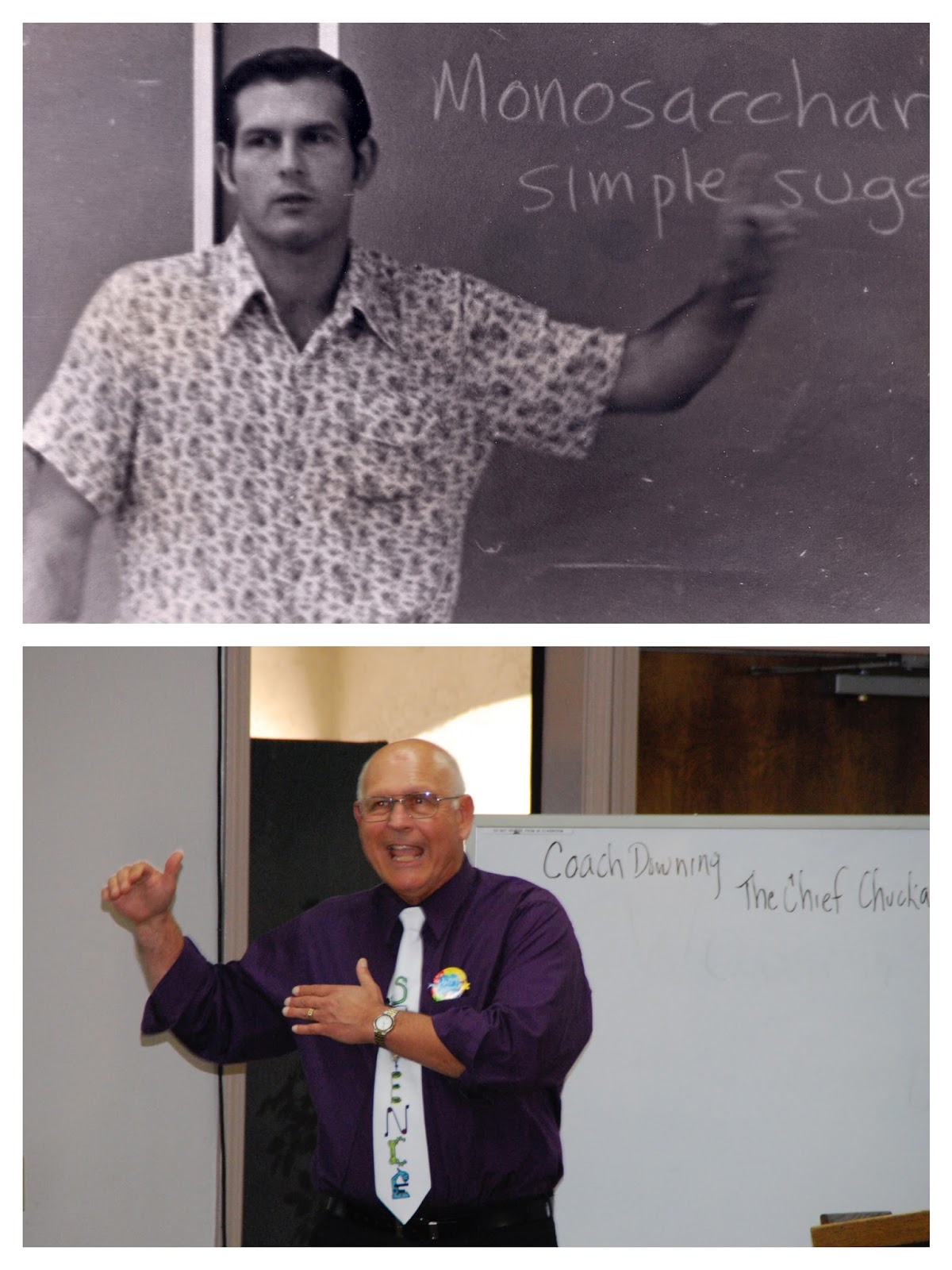
If you can't figure out which was 1973 and which was 2012, I suggest an ophthalmologist appointment.
It’s been 44 years since my first day in Room 1004 at Monte Vista High School. Here’s what I know now.
Assignments are not created equal. In every discipline there are [should be!] assignments designed      1.     for students to learn.  
     2.     for students to know what they don’t know.
           3.     to assess student learning.

Homework most commonly falls under design #1. I learned that I never really knew who did the homework a student turned in. In my heart, I believed each student worked diligently until (s)he completed an assignment. In my mind, I knew that was not the case for every student.

As I moved through my career, grading of homework became a time of communal learning. It was common for homework to be a “trade and grade” activity. The scenario went something like this.
Homework was due when students walked through the door.
Room 507 at Great Oak High School.
In the far left of this photo, you might be able to make a sign with an arrow pointing down to a plastic tray. Sorry for the poor quality of this photo. I didn't check the focus until I'd cleared my room.

I collected homework papers from the tray and brought them to my teaching station.

I checked papers for completeness, usually affixing a pig stamp indicating the degree of completeness.

“Put all writing utensils away,” I said.

“Take a grading pen/pencil from the box on your desk.” Students chose their favorite color. These were the only writing utensils allowed at the desks during a trade and grade of a self-grade session.
I walked down the center aisle of my room and dropped papers on each row.

“Pass these down.” Further directions included “take your own paper,” or “make sure you have the paper from a student that’s not in your row.”

Once all the papers were disseminated, I went through the answers. Students were my eyes and hands as they marked answers as right/wrong, added/subtracted text to an answer, and/or mad other annotations as directed.

Papers were returned to their owners before I collected them and recorded the grades.

Depending on the class, this grading process could be pretty sophisticated. I often used Powerpoint slides as visuals. Below is an example.

Global Science/Pre-AP Biology
Botany Focus Questions
Students are given these directions. I used these in all levels of my high school courses and use them now in the university courses I teach.
How to do focus question assignments
A.   Read glossary at the end of the chapter before reading.
B.    Read any Focus Questions for the assigned pages in that chapter BEFORE reading those pages.
C.    Read the assigned pages. Do not stop reading to write down definitions or answers!
D.   After you have FINISHED reading the assigned pages, write down what you remember. If you don’t know remember something, go back and find the information, and then answer, add to, or correct your answers.
This is part of the PowerPoint I went through. The slide background is the pond I had in my backyard.

Four Focus Questions with Answers.
I explained the point distribution for each question.
Slide 1: the points are self-explanatory.
Slide 2: Definition is one point. Type of plan is one point.
Slide 3: Definition is one point. Each division is worth one point for the first three divisions. To get the final point, there must be a total of five divisions described accurately.
Slide 4: This is the most subjective of the samples. Here, the key point is deciduous leaves fall “all at once” and evergreen leaves don’t. One point for each of those.

After that, all I had to do is answer clarification questions.


Next Almanac Blog will have more examples of the “trade/grade” or “self-grade” process as well has some other hints on homework.

Follow me on Twitter: @CRDowningAuthor and Facebook: https://www.facebook.com/CRDowningAuthor
My website is: www.crdowning.com

I'd appreciate your feedback!